Hyundai Unveils Production Ioniq 9 with Native Tesla Charging Port
Hyundai formally introduced its flagship three-row electric SUV, the Ioniq 9, at the Los Angeles Auto Show today, confirming a significant departure from the charging hardware used by its predecessors. The automaker announced that the Ioniq 9 will be the first Hyundai model to arrive with the North American Charging Standard (NACS) port built directly into the vehicle, eliminating the need for adapters at Tesla Supercharger stations. This hardware shift coincides with the vehicle’s production launch at the Hyundai Motor Group Metaplant in Georgia, a move designed to ensure the SUV qualifies for the full $7,500 federal tax credit once battery sourcing requirements are met.
The technical specifications released during the debut highlight a massive 110.3-kilowatt-hour battery pack, which is notably larger than the unit found in its platform-mate, the Kia EV9. This increased capacity allows the Long Range RWD trim to achieve a projected EPA-estimated range of 335 miles, surpassing many competitors in the family hauler segment. For performance-oriented buyers, the dual-motor Calligraphy variant delivers 422 horsepower and can accelerate from 0 to 60 mph in 4.9 seconds, utilizing a boost mode that temporarily unlocks maximum torque output. Despite the larger battery, the 800-volt architecture supports charging from 10 to 80 percent in just 24 minutes on 350-kW DC fast chargers.
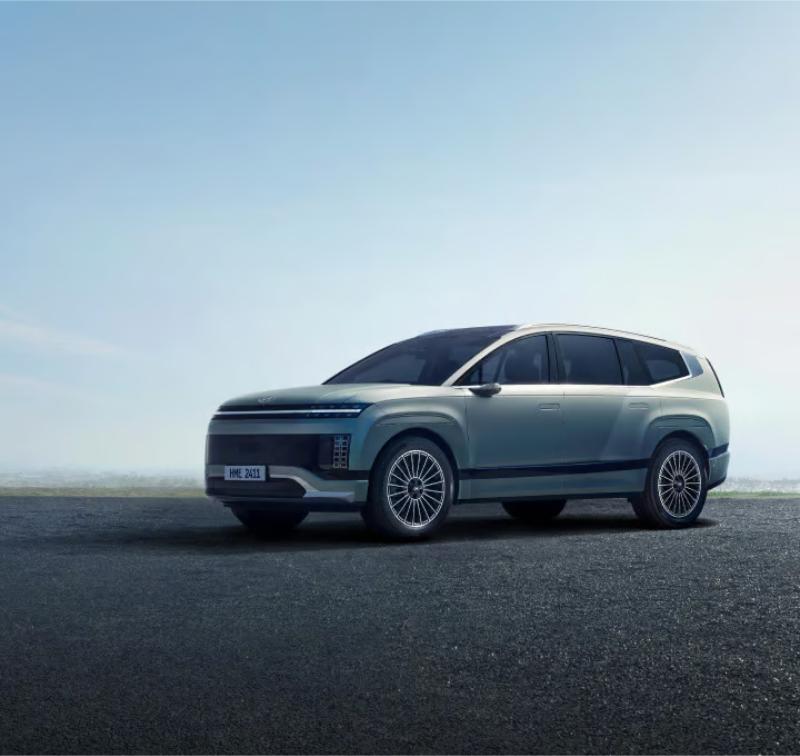
Visually, the Ioniq 9 sheds the boxy aesthetic of traditional SUVs for a streamlined “Aerosthetic” profile, featuring a heavily raked roofline that contributes to a drag coefficient of just 0.259 Cd. Inside, the cabin prioritizes flexibility with a flat floor architecture and a “Universal Island 2.0” center console that can slide nearly eight inches to serve second-row passengers. Hyundai Global COO José Muñoz stated that the interior design was specifically engineered to function as a “lounge on wheels,” incorporating swiveling capabilities in select markets, though North American models will focus on six- and seven-seat configurations with relaxation modes.
Pricing has not been finalized, but industry analysts expect the Ioniq 9 to start in the mid-$50,000 range, undercutting luxury alternatives like the Rivian R1S and the Volvo EX90. Deliveries are scheduled to begin in the United States in the first half of next year, followed by a rollout in European and other global markets. The launch of the Ioniq 9 completes the first phase of Hyundai’s dedicated EV lineup, joining the Ioniq 5 crossover and Ioniq 6 sedan on the E-GMP platform.