
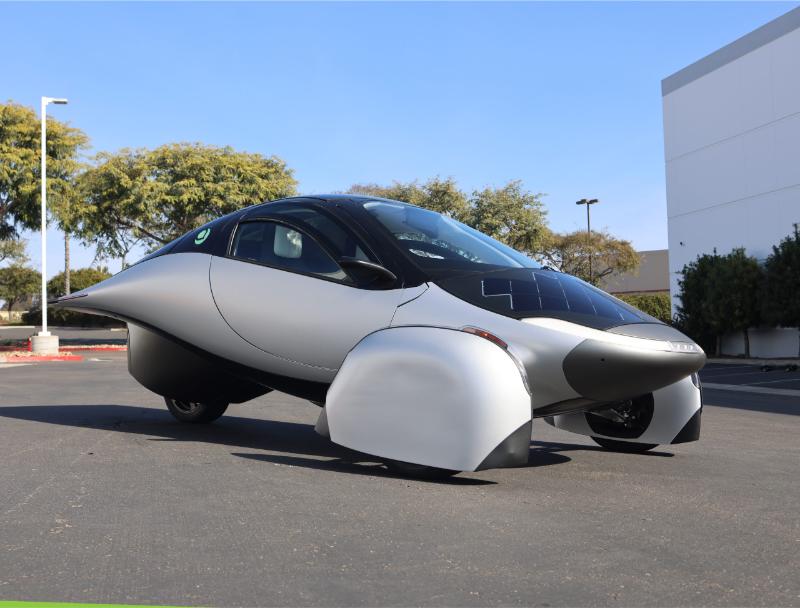
Aptera Motors Reveals Assembly Line for Solar Electric Vehicles
Aptera Motors unveils its dedicated assembly line for validation vehicles, marking a concrete step toward commercializing the world’s first solar electric production car. The three-wheeled ‘Aptera’ employs a lightweight composite body that integrates photovoltaic panels capable of generating up to 40 miles of daily range from sunlight alone. This update coincides with internal testing that exceeds efficiency targets, positioning the startup for low-volume production amid rising demand for ultra-efficient personal transport.
The assembly process follows a traditional linear workflow, with vehicle bodies progressing through 12 stations for component integration. Workers install the 100-kilowatt-hour battery pack, dual electric motors delivering 201 horsepower, and the solar array spanning 700 watts peak output. Each ‘Gemini’ validation prototype, the third-generation test mule, completes assembly in under eight hours, incorporating hand-laid carbon fiber and fiberglass for a curb weight of 1,800 pounds. Quality checks at final stations verify structural integrity against Federal Motor Vehicle Safety Standards for three-wheelers.
Battery production advances at Aptera’s Carlsbad, California facility, where cylindrical cells from a major supplier form modules with liquid cooling channels. The 100-kilowatt-hour configuration achieves 400 miles of EPA-estimated range on a full charge, augmented by solar input equivalent to 10,000 miles annually in sunny climates like Arizona. Internal dynamometer tests log 400 watt-hours per mile at highway speeds, surpassing the 500 wh/mi target through aerodynamic drag coefficients of 0.13—the lowest for any production vehicle.
Efficiency validation includes wind-tunnel refinements to the teardrop-shaped enclosure, reducing turbulence via active grille shutters and underbody panels. Real-world prototypes undergo 1,000-mile endurance runs on Southern California highways, confirming regenerative braking recaptures 70 percent of kinetic energy. Software calibrates power distribution between front and rear motors for stability, achieving 0-60 mph acceleration in 3.5 seconds while maintaining traction on grades up to 20 percent.
Low-volume production targets 25,000 units annually starting late 2026, scaling from the validation phase that builds 50 ‘Gemini’ units by mid-2026. Reservations exceed 5,000, with base pricing at $33,000 for rear-drive models and $38,000 for all-wheel-drive variants. Deliveries prioritize U.S. customers in high-solar regions, supported by a nationwide dealer network under development. Export certifications for Europe follow in 2027, adapting to ECE regulations for low-speed vehicles.
The solar array, comprising 32 flexible monocrystalline cells, withstands 1,000 hours of thermal cycling without degradation. Integration with the 60-kilowatt onboard charger enables Level 2 AC replenishment in five hours, or DC fast-charging to 80 percent in 25 minutes at 150 kilowatts. Aptera’s proprietary energy management system prioritizes solar harvest during peak daylight, extending range by 20 percent over non-solar EVs in equivalent tests.
Chassis engineering emphasizes a low center of gravity at 18 inches, with independent suspension and 18-inch wheels shod in low-rolling-resistance tires. The single-seat cockpit features a 12.3-inch digital cluster and 15.4-inch central touchscreen running Android Automotive OS. Over-the-air updates refine autonomy features, including adaptive cruise and lane-keeping drawn from Mobileye hardware.
Funding rounds totaling $100 million support the ramp-up, with recent investments from United Wholesale Mortgage funding cleanroom expansions. Supply chain localization includes U.S.-sourced composites from a Michigan partner, reducing import dependencies. Aptera projects 95 percent recyclability for end-of-life vehicles, aligning with circular economy standards.
Market positioning targets commuters averaging under 40 miles daily, where solar offsets 80 percent of charging needs. Competitors like the Arcimoto FUV offer similar three-wheel utility but lack integrated photovoltaics. Aptera’s dual-motor setup delivers 160 miles per hour top speed, certified for highway use in 48 states.
Production milestones include first customer validation drives in Q2 2026, gathering data for full EPA certification. The assembly line’s modular design allows future variants, such as a two-passenger extension with 120-kilowatt-hour batteries. Efficiency metrics position the ‘Aptera’ at 150 percent greater solar yield than roof-mounted panels on conventional cars.