Stellantis Launches Fiat Topolino Quadricycle for US Market
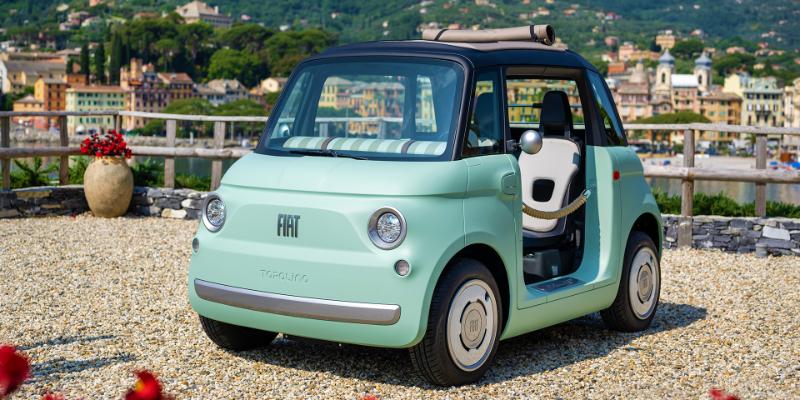
Stellantis NV introduces the ‘Fiat Topolino’ electric quadricycle to American roads, capitalizing on regulatory shifts that ease entry for compact vehicles. This 2.5-meter-long model, classified under quadricycle standards, targets urban commuters seeking low-cost mobility options. Fiat’s move follows President-elect Donald Trump’s praise for similar Japanese Kei cars as “very cute” and “beautiful,” though company officials emphasize the decision predates his remarks.
The ‘Topolino,’ translating to “little mouse” in Italian, features a single electric motor producing 4 kilowatts of power, equivalent to about 5.4 horsepower. Top speed caps at 45 kilometers per hour, or 28 miles per hour, with a lithium-ion battery offering up to 75 kilometers, or 47 miles, of range on a full charge. Vehicle weight falls below 425 kilograms, lighter than most golf carts, enabling simplified certification under National Highway Traffic Safety Administration rules for low-speed vehicles.
Quadricycles like the ‘Topolino’ operate in a regulatory niche separate from standard passenger cars, requiring compliance with Federal Motor Vehicle Safety Standards for speeds under 25 miles per hour. Stellantis leverages this pathway, loosened during Trump’s first term, to bypass stringent crash-test mandates for full-size autos. In Europe, the model qualifies for age-14 licensing in select countries, but U.S. operations will adhere to state-specific rules, typically mandating 16-year-old drivers for low-speed vehicles.
Pricing aligns with affordability goals, listing at approximately 10,500 euros, or $11,500, in Italy including incentives. U.S. versions may adjust for import duties and local taxes, potentially starting under $12,000. Charging occurs via standard household outlets, with full replenishment in four hours using a 1.3-kilowatt onboard charger. Interior accommodates two passengers with 50 liters of cargo space, expandable via fold-flat seats.
Fiat CEO Olivier Francois highlighted “tremendous excitement” from U.S. display appearances at events like the Los Angeles Auto Show. The company plans cargo and three-wheeled variants for commercial fleets, such as last-mile delivery in cities like New York and San Francisco. Production occurs at Stellantis’ Atessa plant in Italy, with initial volumes targeting 5,000 units annually for North America.
This launch positions Stellantis against emerging Chinese micro-EVs entering via similar exemptions. Competitors like the Citroën Ami, another Stellantis quadricycle, have sold over 10,000 units in Europe since 2020. For U.S. consumers, the ‘Topolino’ offers an alternative to e-bikes or scooters, with enclosed cabins for weather protection and four wheels for stability.
Battery chemistry employs LFP cells for longevity, rated at 1,000 charge cycles before 80% capacity retention. Regenerative braking recovers up to 20% of energy in stop-go traffic. Connectivity includes Apple CarPlay and Android Auto via a 7-inch touchscreen, with over-the-air updates for software enhancements.
Market analysts project quadricycle sales to reach 50,000 units in the U.S. by 2030, driven by urban density and parking constraints. Stellantis aims for 15% market share in this segment, integrating the ‘Topolino’ into subscription models priced at $150 monthly. Launch details emerge in mid-2026, with pilot programs in California and Florida.
Safety features encompass ABS, electronic stability control, and hill-start assist, mandatory for quadricycles exceeding 25 kilometers per hour. Impact-absorbing bumpers and pedestrian alert sounds meet Euro NCAP equivalents. For American buyers, this translates to accessible entry into electrification without high upfront costs.
The initiative underscores shifting paradigms in personal transport, blending nostalgia for Fiat’s 1940s original ‘Topolino’ with modern sustainability.